
A bit of history about our vibrant neighbourhood
Spitalfields is an area rich in urban heritage located in a prime development zone immediately adjacent to the City of London. Spitalfields also has a very strong sense of local community with residents enjoying all the amenities normally found in a town much larger than our permanent population could normally sustain. Spitalfields is a cherished urban treasure under great pressure and facing many challenges.
The name “Spitalfields” is derived from two words; Hospital and Fields; and relates to an 11th Century priory hospital called in full, the New Hospital of St. Mary without Bishopsgate. The hospital was established by Walter Brune in 1197 and it existed until the dissolution of 1540 when it fell into ruin and eventually disappeared leaving only its name.
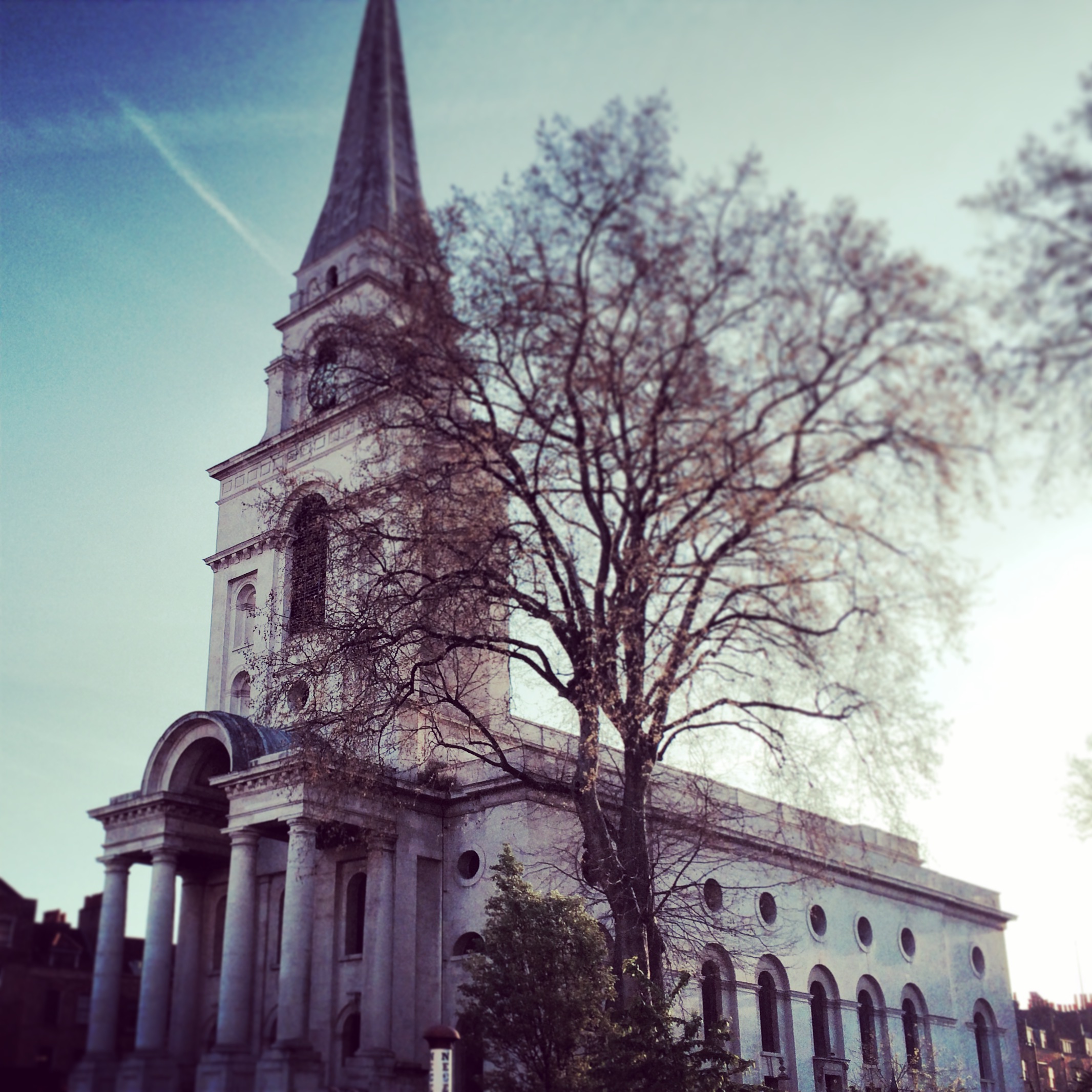
Most of the streets you see today were laid out during the mid 17th Century and owe their place and condition to people of vision such as William Wheler, after whom Wheler Street is so named but dozens of streets around Brick Lane also owe their origins to him; and Thomas Brushfield (see Brushfield Street) who was responsible for a long period of excellent local governance and many local works in the 19th Century which raised the area’s profile and improved the lives of its poorest inhabitants. Then there is John Balch to whom we owe the existence of Spitalfields Market by obtaining letters patent from Charles II in 1682 and his notable successor Robert Horner who oversaw the market’s expansion and is responsible for the present buildings you see today. Finally, there is Nicholas Hawkesmoor who was neither a resident nor worked here but must be thanked for gifting Spitalfields with his finest work; the architectural gemstone which is Christ Church.
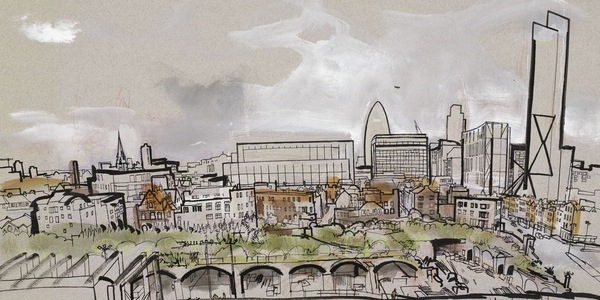
People today are proud to say they live in Spitalfields and this strong local character and identity has deep roots in the enduring civic identity which began with the founding of the priory hospital in 1197 and reach well beyond dissolution right up to the present day.
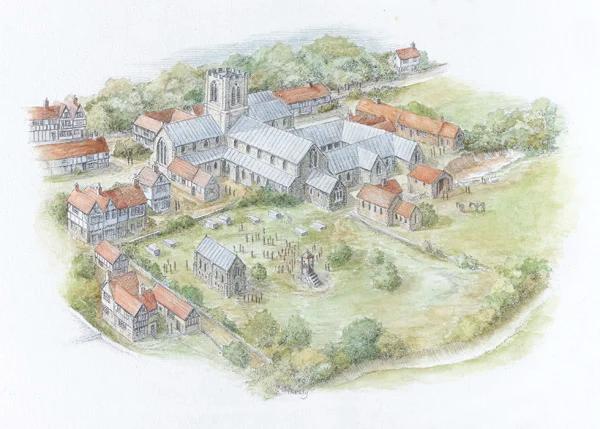
An artists impression of how the Hospital of St. Mary without Bishopsgate may have appeared before its dissolution. (Source: Museum of London)
There are surviving records of town meetings going back to the 17th Century and a separate parish of Spitalfields was established in 1729. Self government was fleeting though, because most of the responsibilities the parish vestry had were taken over by the Whitechapel Board of Works in 1855 which was itself superseded by the Metropolitan Borough of Stepney in 1901 and the London Borough of Tower Hamlets in 1964.
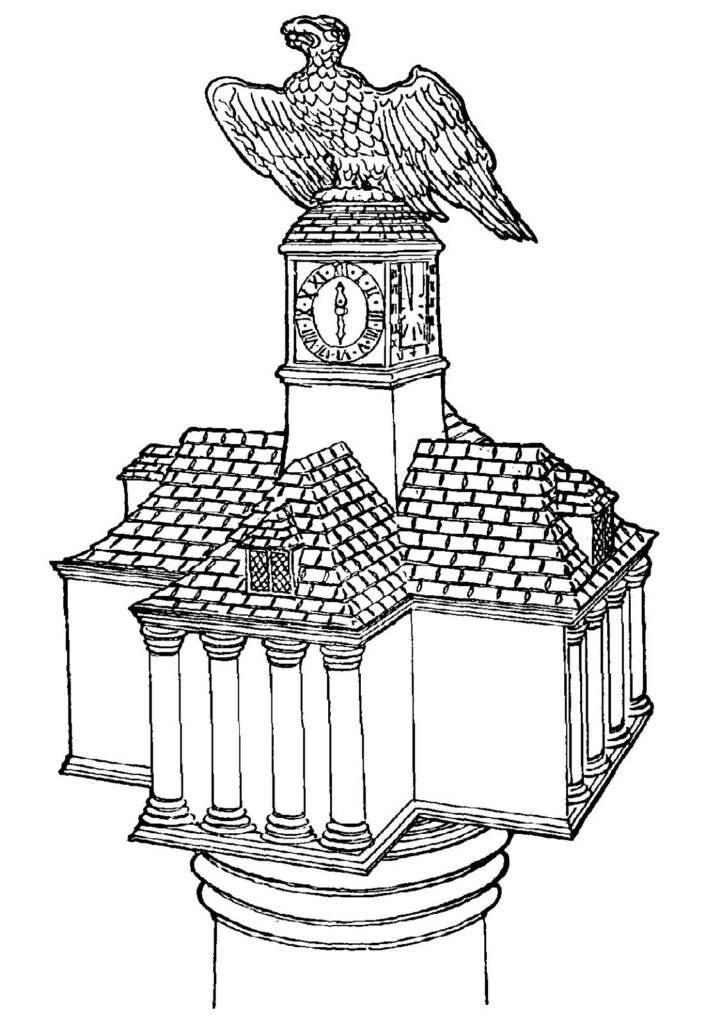
This staff of office, last used by the Church Wardens of Spitalfields, predates the parish and was made in about 1690 when Spitalfields was simply a hamlet. The top of the staff shows the old “Market House” which preceded the market buildings we know today. The records suggest it was gifted to the new Vestry by the the last Market Warden of the former hamlet – so its origins are civic not spiritual.
Until Christ Church was constituted as a separate parish in 1729, and Hawksmoor’s great church was built, Spitalfields formed part of the enormous parish of St. Dunstan’s Stepney. This was originally divided into four hamlets, Ratcliffe, Limehouse, Poplar and Mile End; further subdivision created five more, including the Hamlet of Spitalfields. Records exist for “town meetings” being held in Spitalfields as far back as 1628.
The ratepayers of each hamlet elected a churchwarden, constable, headboroughs, scavengers, and overseers of the poor. These were the officers who served the hamlet for one year, unpaid. Having served they could continue to come to hamlet meetings and vote there; this larger body formed the hamlet vestry, also known as the “ancient or ruling persons of the hamlet”.
The area over which they presided was a good deal more than a hamlet in the usual sense of the word. By the 1680s Spitalfields was already largely built up, to the line of Brick Lane and a little beyond it. It was thickly populated, mainly with weavers and members of the allied trades.
Hamlet meetings were held in a modest building (long since demolished) in Crispin Street, known as the town house or town hall.
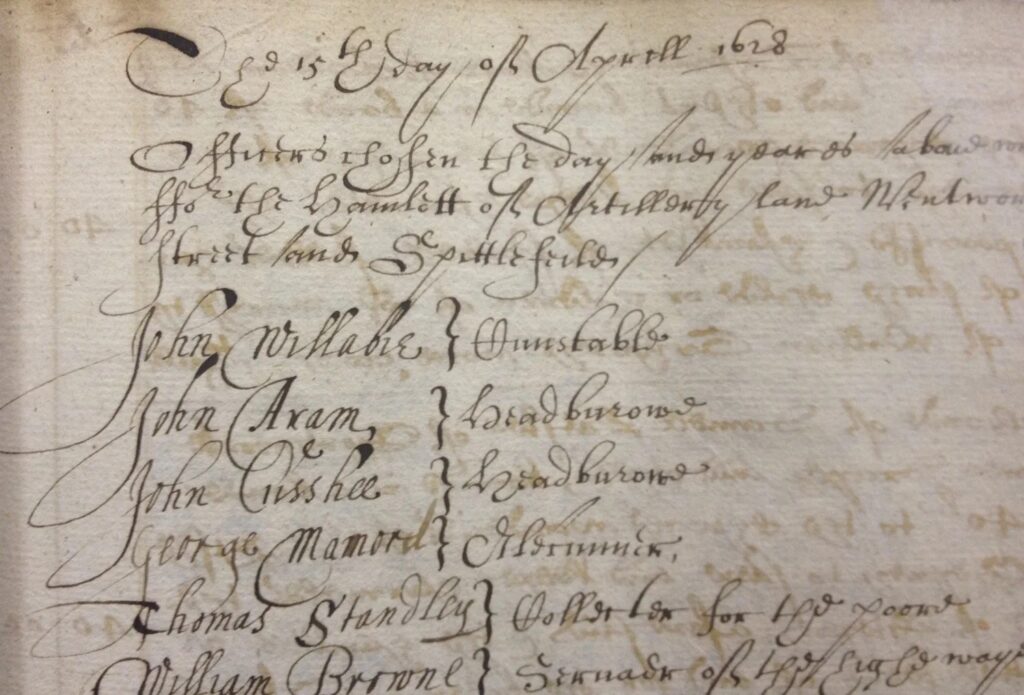
Records of a town meeting held in the “hamlett of Spittlefields” on the 15th day of August 1628. Note the appearance of William Browne who had taken the lease of “three acres of pasture” in 1656 and subsequently laid out the street today called Quaker Street.
VESTRY
The new Parish of Christ Church was established by an Act of Parliament in 1729. The vestry of Christ Church took over the functions, and much of the organisation, of what had been known as the Hamlet of Spitalfields. Minutes of its meetings are preserved at the Bancroft Road Local History Library in Stepney.
The structure of local government which ran the parish was similar to that which ran the hamlet, but there were a number of changes, the most important of which was that while hamlet officers had been elected by the ratepayers, parish officers were appointed, and the gaps in the vestry filled, by the members of the vestry. In short, government in Spitalfields changed from being conducted on a reasonably democratic basis to a government controlled by a self-perpetuating body of richer parishioners. A small group of perhaps a dozen vestrymen occur again and again in the vestry minutes, attending meetings or sitting on various bodies, trusts or committees; together they formed the inner group which ran the parish.
Vestry meetings took place approximately every fortnight in the vestry room within Christ Church and were attended by between 20 and 50 people.
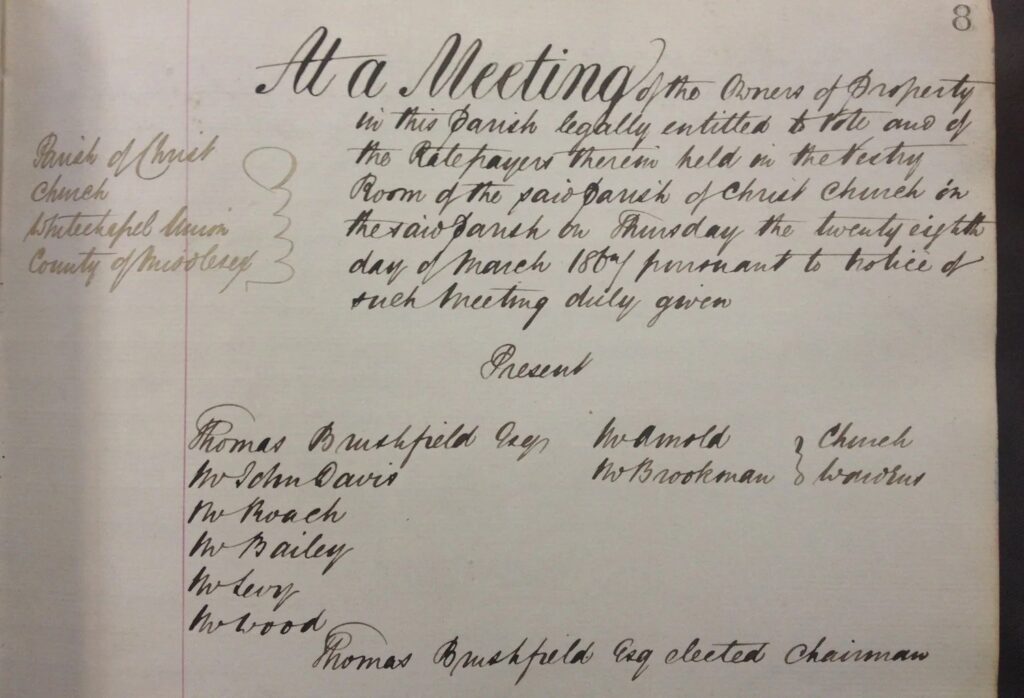
The minutes of a meeting of the Christ Church Vestry, it reads:
“At a Meeting of the Owners of Property in the Parish legally entitled to vote and of the Ratepayers therein held in the Vestry Room of the said parish of Christ Church on Thursday the twenty-eighth day of March 1864 pursuant to notice of such meeting duly given.”
The parish meeting was chaired by Thomas Brushfield Esq. who served the Vestry for many years as chairman and after whom Brushfield Street is so named.
COMMISSIONERS
In 1772 an Act of Parliament saw 59 commissioners appointed to take charge of the roads in Spitalfields. Some of the commissioners were grandees who owned substantial areas of the parish but did not live in it, but many were local people of repute, most and perhaps all of whom were vestrymen. The new commission was closely tied up with the vestry but it was not the vestry; it was an even smaller and equally self-perpetuating body which continued to pave, light, clean and watch the parish. The only secular responsibility now left to the vestry was care of the poor, and it lost that as a result of the Poor Law Act of 1834.
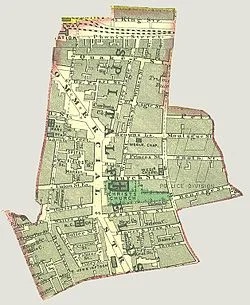
The bounds of the Civil Parish of Spitalfields, c.1885.
In 1899 the Public General Act ordered the creation of new Metropolitan Borough Council’s across the London Metropolis. The Commissioners existed until the newly formed Metropolitan Borough of Stepney came into existance in November 1900.
The borough of Stepney became merged with the new London Borough of Tower Hamlets in 1964 and since then all civil affairs in Spitalfields have been the exclusive preserve of Tower Hamlets council.
Nevertheless, since 1900, Spitalfields has always existed as ward for local government election purposes although the size and shape of the ward and the number of councillors elected to represent it have varied considerably.
As local government fluctuated so did the quality of life enjoyed by the people of Spitalfields. The fine Georgian houses many people come to see that are found in Norton Folgate and in the streets nighest the church hark back to a time when parts of Spitalfields were quite industrious and well-to-do. The population of skilled Huguenot refugees who gathered here in the late 17th Century developed silk-weaving and can be thanked for most of the surviving buildings of note. As the Huguenots gradually became indistinguishable from the surrounding London stock they also moved out and were replaced by subsequent influxes of impoverished Jews and Irish. By the advent of the Victorian Era the area had declined into the capital’s most notorious rookery and the fine houses now found themselves the densely occupied homes of a population described by contemporaneous writers as squalid, destitute and debauched. The population weathered Hitler’s bombs and after the War, as we entered the New Elizabethan Era, change came once again as artisans and further waves of settlers began conserving, improving and reinvigorating this precious place until it became the celebrated neighbourhood we know today.
The Spitalfields Society was formed as an amenity society by local residents in 1992 and ever since its foundation the society has devoted itself to improving Spitalfields as a place to live, work and visit. We hope it continues to do so for many years to come.
If you would like to get involved, learn more or even join us – please contact us here.
Sources and attributions:
Mark Girouard, Local Government in Spitalfields in the 18th Century
Survey of London: Volume 27, Spitalfields and Mile End New Town. Originally published by London County Council, London, 1957.